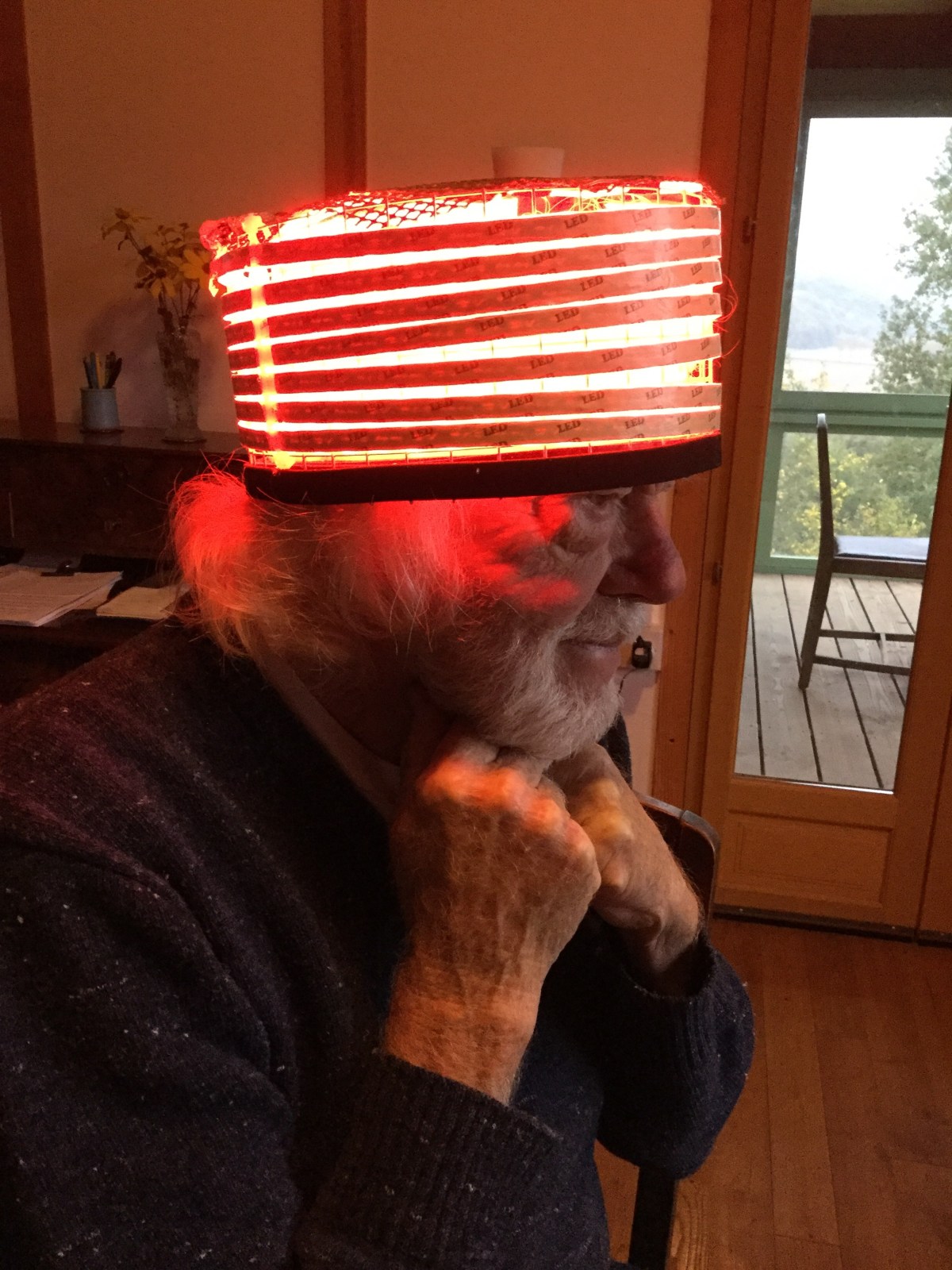
When Rajeev Chaurasia’s father was diagnosed with Parkinson’s disease, Rajeev put his creativity and DIY skills to use in making a Cossack light hat for him.
Rajeev has devised new ways to style it and make it easier to construct.
This marvellous video – the work of Rajeev, his daughter Renee and his friend Karl Mascarenhas – shows some very clever ideas for making a Cossack light hat at home. Rajeev, Renee and Karl have kindly given permission to the blog to host their video.
Watch this video to see a new Cossack style being made.
Some say that a red light source must be able to shine from one side of your hand to the other otherwise it won’t have the grunt to penetrate through the skull and into the brain tissue.
For amusement, we put that to the test. We took one of the individual 670nm LEDs used in the Well Red Coronet* and tested it out.
For the detailed results, click here. Spoiler alert: It worked magnificently.
So what about the red lights in LED strips that we use in Cossacks?
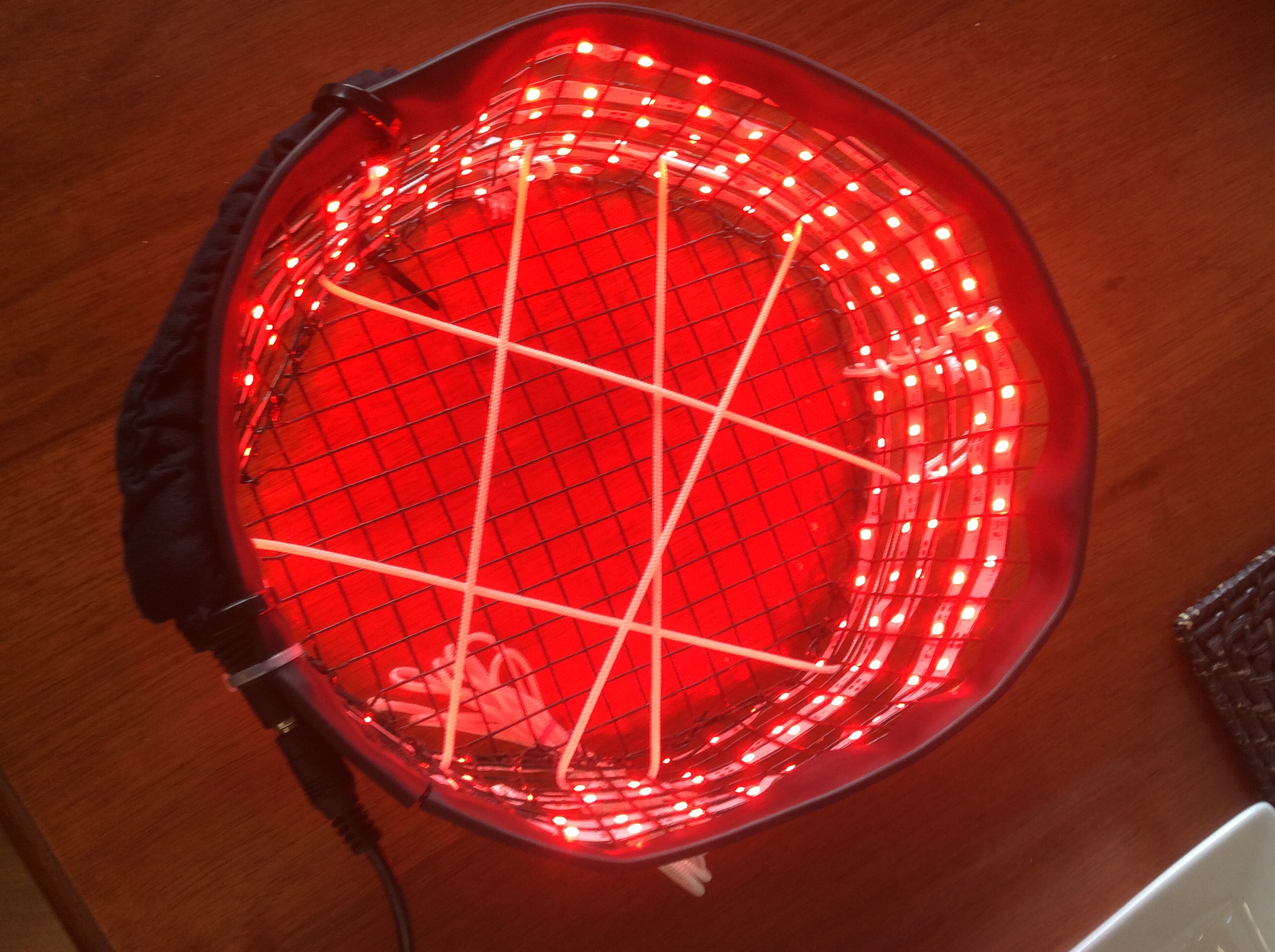
Cossack light hat. Click on the DIY menu item for instructions.
I’ve been testing out a strip of 670nm LED strip. I masked the lights on the LED strip and only left 4 little LED lights shining. In the dark, they looked pretty bright, but when I put my hand over them, I couldn’t see any red light coming through. So I can say categorically that 4 little LEDs on a red LED strip don’t pass the Hand Test.
However, in the Cossack we use a full 5 metre LED strip just around the outside of the frame, so that’s an awful lot of individual LEDs shining onto your head. It is very possible that the light from a clump of LEDs from LED strips will penetrate through the hand.
I’d suggest, though, that you don’t worry about this concept, and just get cracking on making your Cossack. It may be home-made, but I’ve had consistent positive feedback from Cossack-wearers all over the world.
Cossacks can and do help. As long as they are worn, of course!
* For interest, there are 40 of these LEDs in the Coronet.
Why I recommend making a Cossack rather than an Eliza bucket hat.
If you are thinking of buying a light device, make sure that it is made with individual LEDs, not a LED strip.
A device with individual LEDs is more likely to last, it will have better heat management, and it is more likely to be value for money.
As an example, a few weeks ago I made a LED strip device for my back. It uses standard gel-covered LED strip – the sewing is a bit weird but it was functional and felt pretty nice on my back after a day in the garden.
When I first made it, all three LED strips worked very happily. But as of yesterday, one of the LED strips decided to stop working part-way along its length. LED strips do that – they just stop lighting up.
There’s not much I can do about the bung LED strip. I’ll continue to use my home-made device on my back for the moment, but if more of the LED strips decide to conk out, I’ll pull it apart and make another.
The lesson is clear, though.
If you are thinking of buying a commercial light device, avoid those made with LED strips.
Constant knee pain makes it hard to be active, so in mid 2015, I did a lot of sitting and reading. One of the books was Norman Doidge’s The Brain’s Way of Healing. He mentioned the positive effect of red and near infrared light on arthritic joints and damaged tendons, and on brains.




 Red lights on the brain